Hey, have you heard the shocking news from South Korea? In a historic and unanimous decision, the Constitutional Court has officially removed President Yoon Suk Yeol from office! This bombshell ruling marks a pivotal moment in South Korean politics that will have far-reaching implications for the nation's future. Let's dive into what happened and why this matters so much! 😮
Table of Contents
- The Constitutional Court's Decision
- Background: What Led to the Impeachment
- The Martial Law Declaration
- Constitutional Violations
- The Court's Reasoning
- Immediate Aftermath and Next Steps
- Key Takeaways
The Constitutional Court's Decision 📜
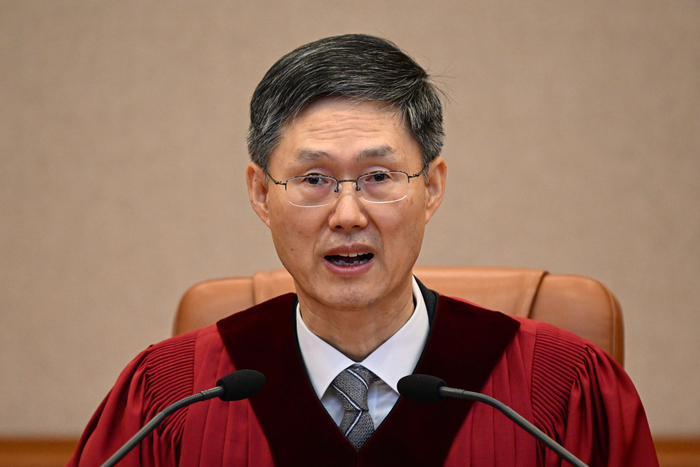
On April 4, 2025, at precisely 11:22 AM, Acting Chief Justice Moon Hyung-bae delivered the verdict that sent shockwaves throughout South Korea and beyond: "The defendant, President Yoon Suk Yeol, is impeached." 😱
In an extraordinary 8-0 unanimous decision, the Constitutional Court upheld the National Assembly's impeachment motion against President Yoon, effectively removing him from office immediately. The ruling came 122 days after Yoon declared martial law on December 3, 2024, and 111 days after the parliamentary impeachment motion was filed on December 14.
"The defendant (President Yoon) mobilized the military and police to undermine the authority of constitutional institutions such as the National Assembly and abandoned his duty to protect the Constitution by violating the basic human rights of the people."
Background: What Led to the Impeachment 🧩
The impeachment saga began on December 3, 2024, when President Yoon made the shocking decision to declare martial law. In a televised address to the nation at 10:27 PM, Yoon claimed that "the Republic of Korea is in a state of paralysis due to the opposition party's impeachment efforts, special prosecution investigations, and budget cuts." He further justified his actions by citing threats from "North Korean communist forces." 🚨
Following this declaration, Yoon appointed Army Chief of Staff Park Ansu as martial law commander, who then issued Martial Law Decree No. 1 at 11:23 PM the same night. This dramatic sequence of events triggered immediate backlash and ultimately led to the National Assembly filing an impeachment motion against Yoon on December 14, 2024.
The Martial Law Declaration ⚠️
The Constitutional Court found that Yoon's declaration of martial law failed to meet the necessary legal and constitutional requirements. The court determined that:
- The conditions required for declaring martial law were not present at the time
- The National Assembly's exercise of its constitutional powers (impeachment, legislation, budget review) did not constitute a "grave crisis" warranting martial law
- Any issues with the National Assembly could have been addressed through ordinary constitutional means
- Political deadlocks should be resolved through "political, institutional, and judicial means, not by mobilizing troops" 🚫
The court dismissed Yoon's defense that the martial law was merely "cautionary" and meant as an appeal to the public, stating this reasoning was inconsistent with the purpose of martial law as outlined in the Martial Law Act.
Constitutional Violations 📋
The court identified several specific violations committed by President Yoon:
- Military and Police Deployment to the National Assembly: Yoon ordered security forces to break into the National Assembly on the evening of the martial law declaration, violating the separation of powers and undermining representative democracy.
- Attempted Seizure of National Election Commission Servers: Forces were sent to seize servers at the National Election Commission without proper legal authority.
- Illegal Surveillance: Yoon authorized tracking the location of numerous jurists and politicians without warrants.
- Unconstitutional Martial Law Decree: The decree banned activities of the National Assembly, regional assemblies, and political parties, violating constitutional provisions and infringing on citizens' fundamental rights.
The Court's Reasoning 🧠
The Constitutional Court's decision emphasized several key points in its 114-page, 92,000-character ruling:
On the abuse of presidential power: "The president's authority is granted by, and therefore limited by, the Constitution. The respondent stepped outside the constitutional limits of that authority regarding national emergencies, an area where the president should exercise the most discretion when exercising his or her authority, thereby arousing public distrust in presidential authority." 😡
On democratic principles: "The expression of political views and public decision-making must be concordant with the laws of democracy guaranteed by the Constitution... The National Assembly should have respected the opinions of the minority and, with tolerance and restraint, striven to reach a conclusion with its relationship with the government through dialogue and compromise."
On Yoon's failure as president: "The respondent violated the Constitution and laws when declaring martial law, harkening back to instances in South Korean history when the president's authority in times of national emergencies were abused, leaving the South Korean people stunned and plunging the country's society, economy, politics and foreign affairs policies into chaos." 😔
Immediate Aftermath and Next Steps 🔮
Following the court's decision, Yoon immediately lost his position as president. Later that day, around 5:00 PM, the now-former president met with People Power Party leaders Reps. Kwon Young-se and Kweon Seong-dong at his residence in Yongsan, central Seoul. During this meeting, Yoon reportedly told them he hopes the party wins the upcoming presidential election to choose his successor. 🗳️
According to South Korean law, a presidential election must be held within 60 days to select Yoon's replacement. In the meantime, the prime minister will serve as acting president.
The impeachment and removal of Yoon marks only the second time in South Korean history that a sitting president has been removed from office through impeachment, following the 2017 removal of former President Park Geun-hye.
Key Takeaways 📝
- President Yoon Suk Yeol has been removed from office following a unanimous Constitutional Court decision
- The court found that Yoon committed grave violations of the Constitution by declaring martial law and deploying military forces against other constitutional institutions
- The ruling emphasized that political conflicts should be resolved through democratic means, not through the abuse of emergency powers
- A presidential election will be held within 60 days to select Yoon's replacement
- This historic decision underscores South Korea's commitment to constitutional democracy and the rule of law ⚖️
What do you think about this historic decision? Will it strengthen South Korean democracy or lead to further political polarization? Share your thoughts in the comments below! 💭